
Singapore enters 2026 with a challenge familiar to small, highly open economies: how to protect domestic stability when many of the biggest economic forces originate overseas. Changes in global demand, energy prices, shipping costs, major-country interest rates and geopolitical risks can quickly affect local businesses and consumers.
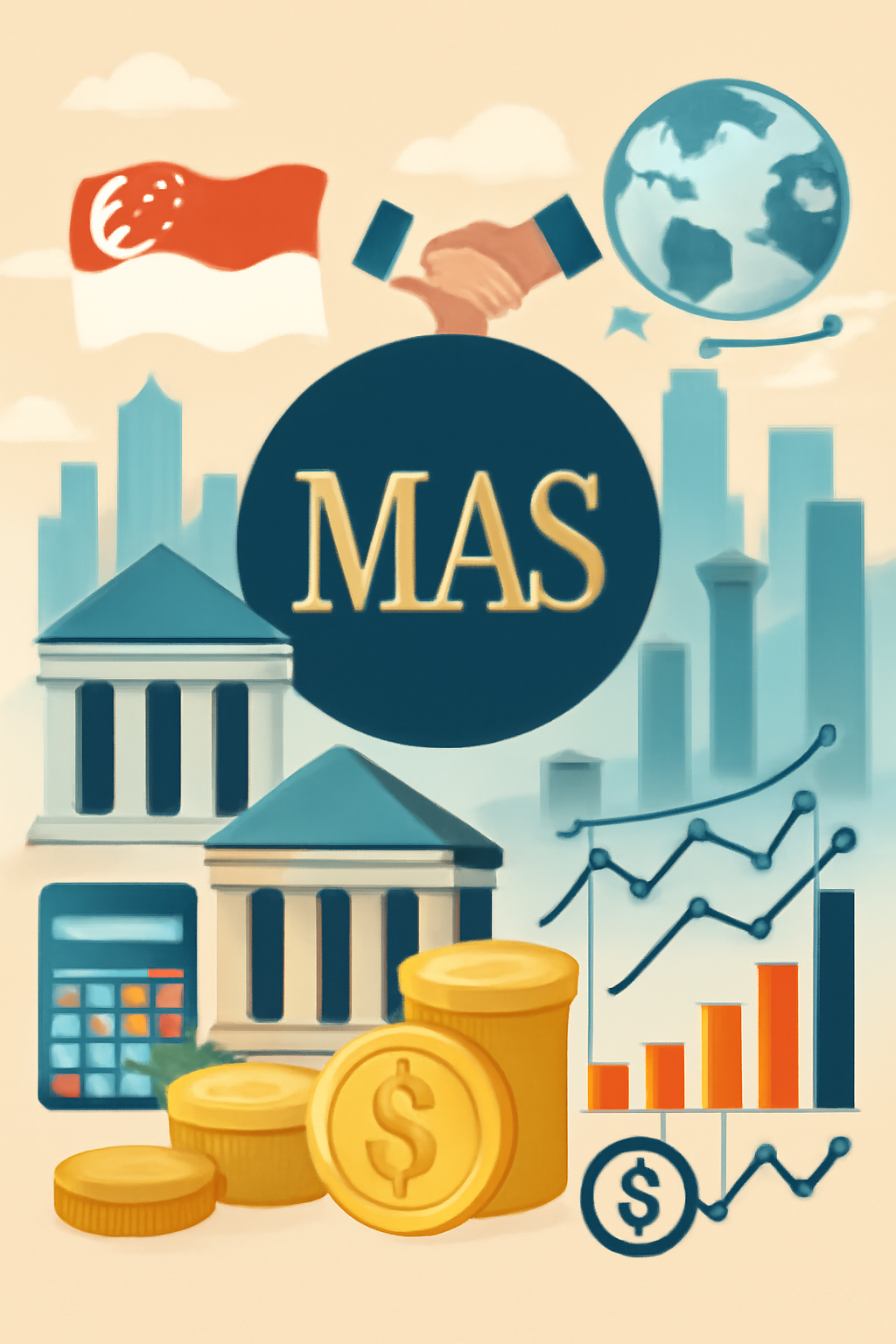
At the centre of Singapore’s response is the Monetary Authority of Singapore, or MAS. Unlike many central banks that primarily influence the economy by changing a benchmark interest rate, MAS conducts monetary policy mainly through the exchange rate.
That distinction is critical to understanding how Singapore seeks to control inflation while preserving sustainable growth.
Why Singapore Uses the Exchange Rate as Its Main Monetary Tool
Singapore imports a large share of the goods and inputs consumed by households and businesses. Food, fuel, machinery and industrial materials are all affected by international prices and currency movements.
Because of this structure, the value of the Singapore dollar has a direct influence on domestic inflation. A stronger currency can reduce the local cost of imported goods, while an excessively weak currency can make foreign products and raw materials more expensive.
MAS therefore manages the Singapore dollar against a trade-weighted basket of currencies known as the Singapore Dollar Nominal Effective Exchange Rate, or S$NEER.
According to the official MAS monetary policy framework, the exchange rate is allowed to fluctuate within a policy band. MAS can adjust the slope, width or centre of that band depending on inflation risks and economic conditions.
This framework gives the central bank a way to influence imported inflation without attempting to defend one fixed exchange rate against a single foreign currency.
The 2026 Challenge: Controlling Inflation Without Choking Growth
The policy dilemma in 2026 is likely to centre on balance.
Keeping the Singapore dollar too strong for too long could place pressure on exporters and businesses that earn revenue overseas. Allowing the currency to weaken too quickly, however, could raise the domestic price of imported necessities and production inputs.
This is why MAS policy is closely watched by manufacturers, retailers, banks, property investors and multinational companies.
The policy backdrop entering 2026 is especially relevant. During 2025, the central bank had to respond to a changing combination of inflation pressures and weaker external growth risks. That experience showed how quickly monetary conditions can shift when global trade expectations, financial markets and price pressures move in different directions.
For 2026, businesses will therefore pay close attention not only to whether MAS tightens or eases policy, but also to the language used in its assessments of inflation, output and external demand.
Financial Stability Extends Beyond Currency Management
MAS also serves as Singapore’s integrated financial regulator. Its role includes supervising banks, insurers and other financial institutions while monitoring threats that could spread across the financial system.
This matters because monetary stability can be undermined by excessive borrowing, weak lending standards or sudden stress in global markets.
A resilient banking system allows households and companies to continue accessing credit during periods of uncertainty. Strong capital, liquidity and risk-management requirements also reduce the possibility that problems at one institution could become a broader economic crisis.
What Businesses and Households Should Watch in 2026
Three issues deserve particular attention: imported inflation, external demand and financial-market volatility.
A renewed rise in energy or shipping costs could strengthen inflation pressures. A slowdown among Singapore’s major trading partners could weaken exports. Sharp currency and interest-rate movements could also affect corporate financing and investment decisions.
MAS cannot eliminate these risks. Its importance lies in reducing the likelihood that an external shock develops into a domestic stability crisis.
In 2026, the central bank’s effectiveness will depend on careful policy calibration: keeping inflation expectations contained, allowing the currency to absorb external pressures and ensuring that Singapore’s financial system remains strong enough to support long-term economic activity.