
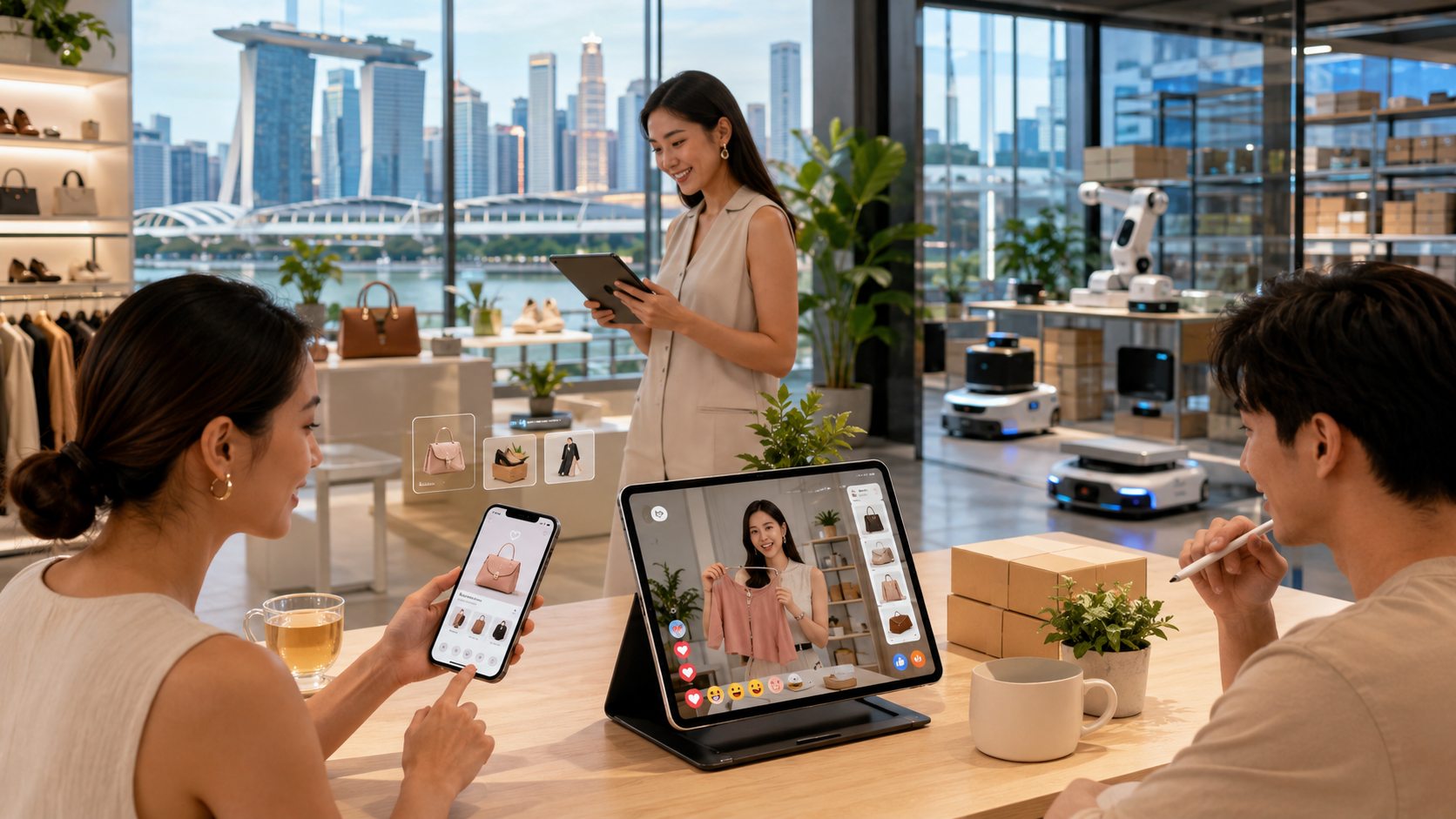
Singapore’s Digital Retail Market Is Entering a More Intelligent Phase
Singapore’s e-commerce sector is moving beyond basic online storefronts. In 2026, the competitive advantage for local start-ups increasingly depends on how effectively they can understand customer intent, predict demand and personalise each stage of the shopping journey.
The city-state offers an ideal testing environment for retail technology. Consumers are highly connected, digital payments are widely accepted and delivery expectations are demanding. At the same time, the market is relatively small, forcing start-ups to improve customer retention instead of relying only on rapid user acquisition.
Singapore’s Department of Statistics tracks online transactions as part of its monthly retail sales indicators, demonstrating how digital commerce has become an established component of the national retail economy. The official retail trade data can be accessed through the Singapore Department of Statistics.
Artificial Intelligence Is Becoming a Commercial Tool
Artificial intelligence is no longer limited to experimental chatbots. E-commerce companies are applying machine learning to product recommendations, customer service, inventory forecasting, pricing and fraud detection.
A beauty marketplace, for example, can analyse a shopper’s previous purchases, preferred ingredients and browsing behaviour before recommending suitable products. A fashion platform can use predictive models to estimate which sizes, colours and styles are most likely to sell in particular customer segments.
These systems allow start-ups to present smaller but more relevant product selections. This matters in an environment where shoppers are frequently overwhelmed by thousands of similar listings.
Personalisation Is Shifting From Products to Entire Shopping Journeys
The strongest platforms are not only recommending products. They are personalising the timing, content and channel of every interaction.
A returning customer may receive an app notification when a frequently purchased item is running low. Another shopper may be shown a short video rather than a conventional product page because previous behaviour indicates stronger engagement with visual content.
This approach helps retailers reduce unnecessary promotional spending. Instead of sending the same discount to an entire database, companies can identify customers who are likely to purchase without an incentive and reserve promotions for more price-sensitive groups.
Singapore Start-Ups Still Face a Data Challenge
Advanced personalisation requires detailed customer information, but consumers are becoming more cautious about how businesses collect and use their data. Start-ups must therefore balance commercial relevance with transparency.
Responsible companies are placing greater emphasis on first-party data obtained directly from transactions, loyalty programmes and voluntary customer preferences. They are also giving shoppers clearer control over marketing consent and recommendation settings.
This is particularly important in Singapore, where compliance with the Personal Data Protection Act can affect product design, advertising practices and customer analytics.
Operational Intelligence May Be More Valuable Than Flashy Features
Some of the most important AI applications are invisible to shoppers. Demand forecasting can help start-ups avoid overstocking slow-moving products. Automated inventory allocation can position goods closer to areas where orders are expected. Customer-service software can categorise requests and direct complex cases to human agents.
For businesses operating on narrow margins, these improvements can be more valuable than attention-grabbing consumer features. Better forecasting reduces storage costs, while faster problem resolution can prevent refunds and negative reviews.
The 2026 Competitive Advantage Is Relevance
Singapore’s next generation of e-commerce leaders will not necessarily be the companies with the largest catalogues. They are more likely to be businesses that deliver relevant recommendations, accurate availability information and consistent service across websites, apps and physical locations.
AI can support that experience, but technology alone is not enough. The strongest start-ups will combine automated decision-making with transparent data practices, reliable fulfilment and a clear understanding of why customers choose one retailer over another.