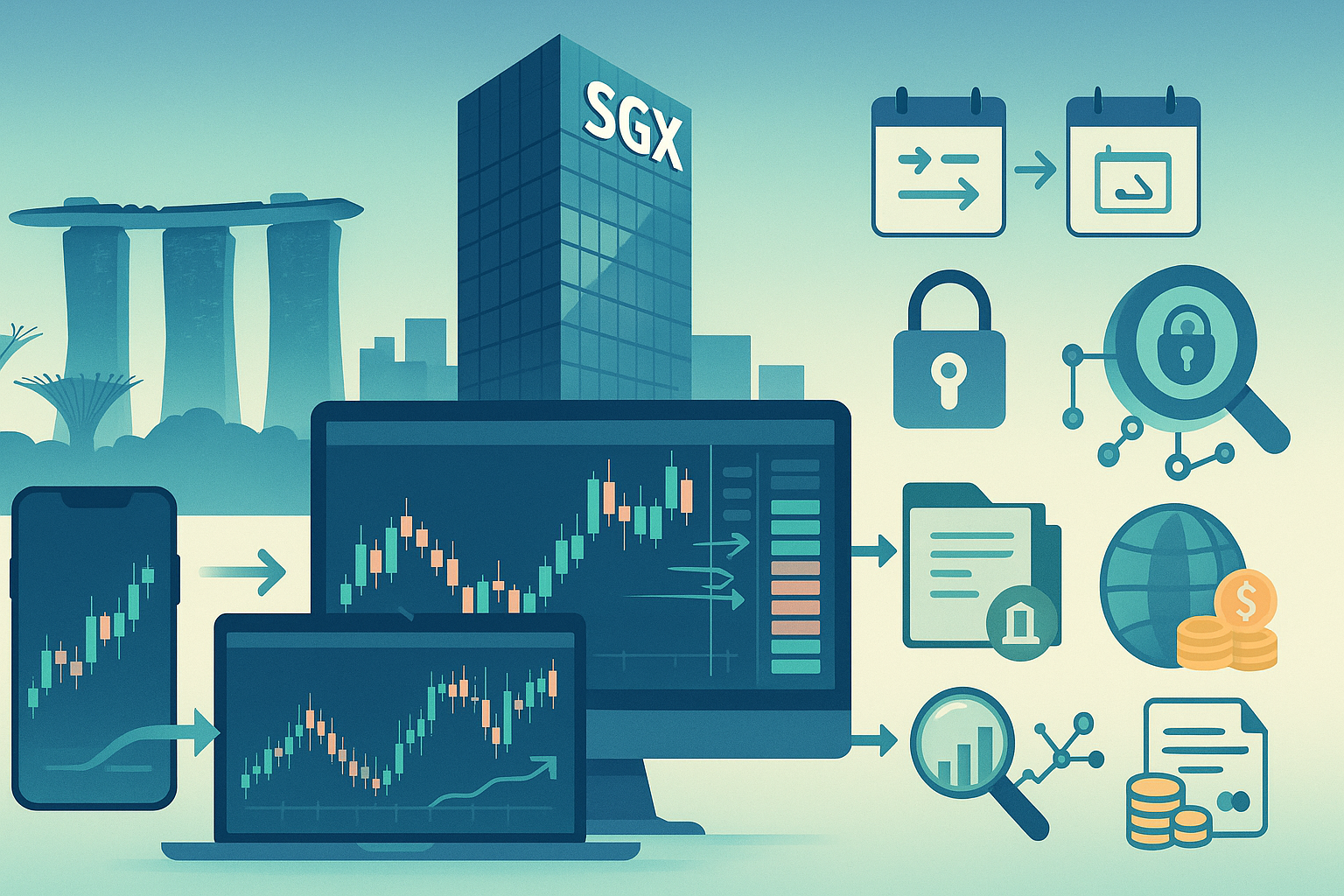

Singapore’s derivatives market is becoming increasingly important as investors search for efficient ways to manage volatility across Asian equities, currencies and commodities. Rather than functioning solely as a venue for speculative trading, the market now supports portfolio protection, price discovery and cross-border exposure.
Heading into 2026, investors are preparing for continued uncertainty surrounding interest rates, Chinese economic growth, commodity demand and currency movements. Singapore is strategically positioned within this environment because the Singapore Exchange, or SGX, offers contracts linked to several major Asian markets without requiring investors to trade directly in every underlying jurisdiction.
The exchange’s official SGX Derivatives portal provides contract information, market data and product specifications covering equity indices, foreign exchange, commodities and other derivative instruments.
Futures Provide Efficient Access to Asian Markets
Futures remain the foundation of Singapore’s derivatives ecosystem. Contracts such as SGX FTSE China A50 Index Futures allow international investors to respond to developments in mainland Chinese equities, including when some regional cash markets are unavailable.
Currency futures, particularly contracts connected to the offshore Chinese yuan, also play an important role. Exporters, asset managers and multinational companies can use these instruments to manage the impact of exchange-rate changes on revenues, investments and operating costs.
Singapore is also influential in commodity derivatives. Iron ore contracts traded through SGX are widely followed by mining companies, steel producers, commodity traders and financial institutions. These contracts provide a reference point for expectations surrounding Chinese steel production and global industrial demand.
A steel manufacturer expecting iron ore costs to rise, for example, may buy futures to reduce the risk of paying significantly higher prices later. A mining company concerned about falling prices may take the opposite position to protect future revenue.
Options Add Flexibility to Portfolio Protection
Options give investors the right, but not the obligation, to buy or sell an underlying asset at a predetermined price. This feature makes options useful when investors want protection while retaining some upside potential.
A fund holding Asian equities could purchase put options to limit losses during a market correction. Unlike selling the entire portfolio, the strategy allows the investor to maintain long-term exposure. The cost of this protection is the option premium.
More experienced participants may use spreads, collars or covered-call strategies. A collar combines a protective put with the sale of a call option, potentially reducing hedging expenses. Covered calls can generate premium income, although they may limit gains when markets rise sharply.
Strategic Use Matters More Than Trading Frequency
The development of Singapore’s derivatives market does not mean investors should increase leverage without clear limits. Futures and options can magnify losses when positions are poorly sized or margin requirements are misunderstood.
Professional investors usually begin by identifying the specific risk they want to manage. They then select a contract with suitable liquidity, expiry and exposure. Position limits, stop-loss rules and stress testing are equally important.
For investors navigating Asian markets in 2026, Singapore’s derivatives ecosystem offers more than short-term trading opportunities. Its strongest value lies in connecting regional exposures with disciplined tools for hedging currencies, equities and commodities.