
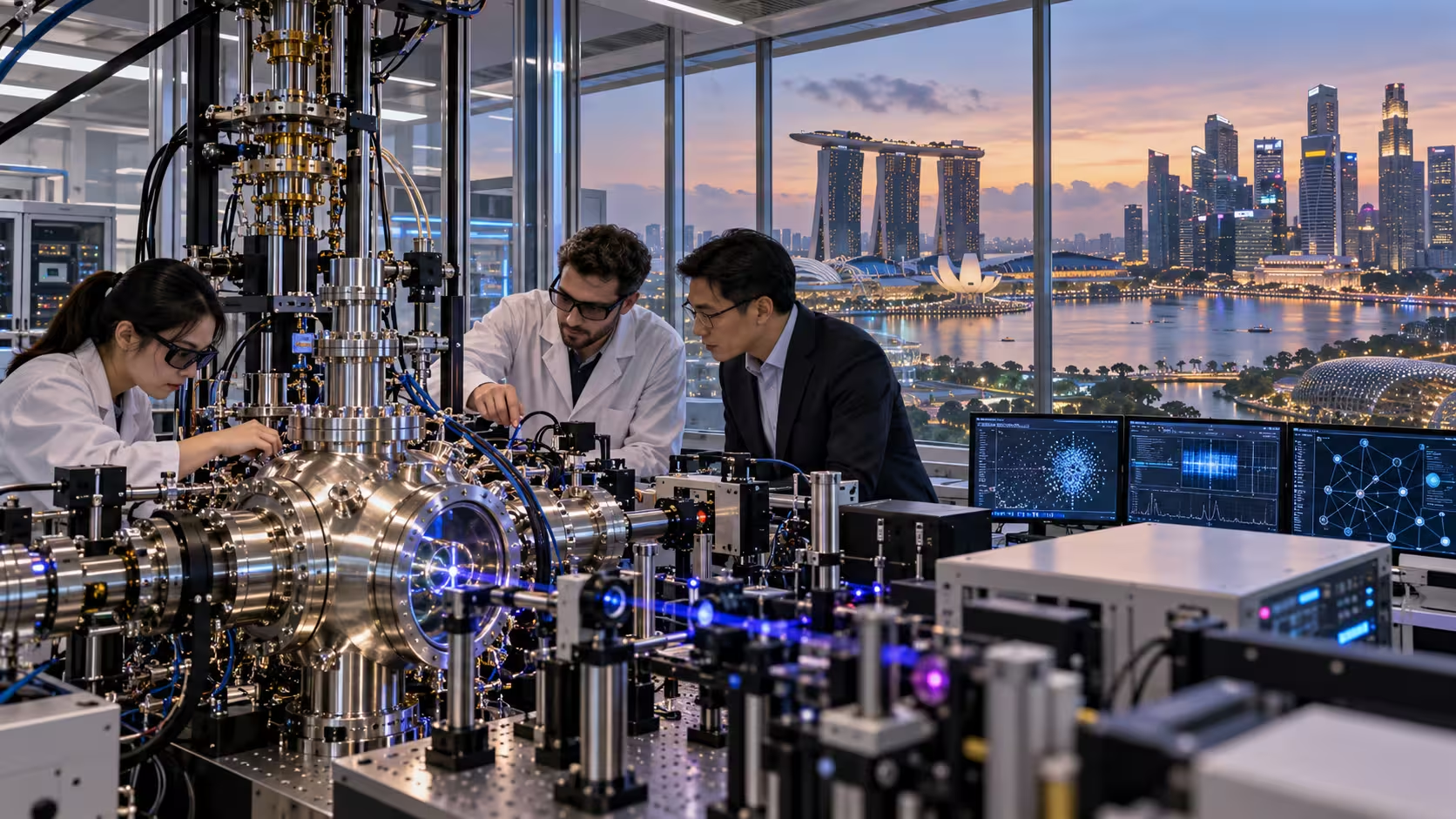
From Lab to Industry: The Strategic Pivot
Singapore has spent over two decades building quantum research credentials. In 2026, the city-state is executing a decisive shift from laboratory science to industrial deployment, backed by one of the world’s most aggressive national quantum investment programs. The S$37 billion Research, Innovation and Enterprise 2030 (RIE2030) plan, released in December 2025 and detailed further in August 2026, identifies quantum technology as a strategic pillar alongside AI and advanced computing.
National Research Foundation Chairman Heng Swee Keat framed the stakes clearly at the 3rd Quantum Industry Day in April 2026: “Quantum technologies are moving from the laboratory into real-world applications”.
The Helios Deployment: A First Outside the US
The most visible manifestation of Singapore’s quantum ambitions is the planned installation of Quantinuum’s Helios trapped-ion quantum computer, expected to be completed by late 2026. Singapore will become the first country outside the United States to host this system, giving local researchers direct access to one of the most advanced commercial quantum computers available.
As a full-stack platform, Helios combines a fully connected physical and logical qubit architecture with industry-leading fidelity and a next-generation software stack, including a high-level programming language designed to accelerate quantum computing adoption. Cloud access to Helios has already been available to researchers since late 2025, enabling capability-building even before physical installation.
Five National Programs, One Coordinated Vision
Singapore’s quantum architecture is anchored by five National-level Quantum Programmes: the National Quantum Computing Hub (NQCH), the National Quantum Federated Foundry (NQFF), the National Quantum-Safe Network (NQSN), the National Quantum Processor Initiative (NQPI), and the National Quantum Sensor Programme (NQSP). These serve as focal points for research translation, industry collaboration, and capability building.
Real Applications, Real Sectors
The initial programs under the Quantinuum partnership target computational biology and drug discovery, financial modeling, advanced materials chemistry, and combinatorial optimization. In July 2026, UOB and the Centre for Quantum Technologies launched a collaboration examining whether quantum techniques could improve the valuation of path-dependent financial derivatives, an area relying on computationally intensive Monte Carlo simulations.
The Challenges Ahead
Singapore’s ambitions face significant headwinds. The global quantum talent shortage, combined with Singapore’s demographic constraints — total fertility rate dropped to a historic low of 0.87 — creates structural recruitment challenges. Competition from other sectors for skilled engineers compounds the problem. Additionally, practical quantum advantage remains years away, requiring sustained investment through uncertain technological timelines.