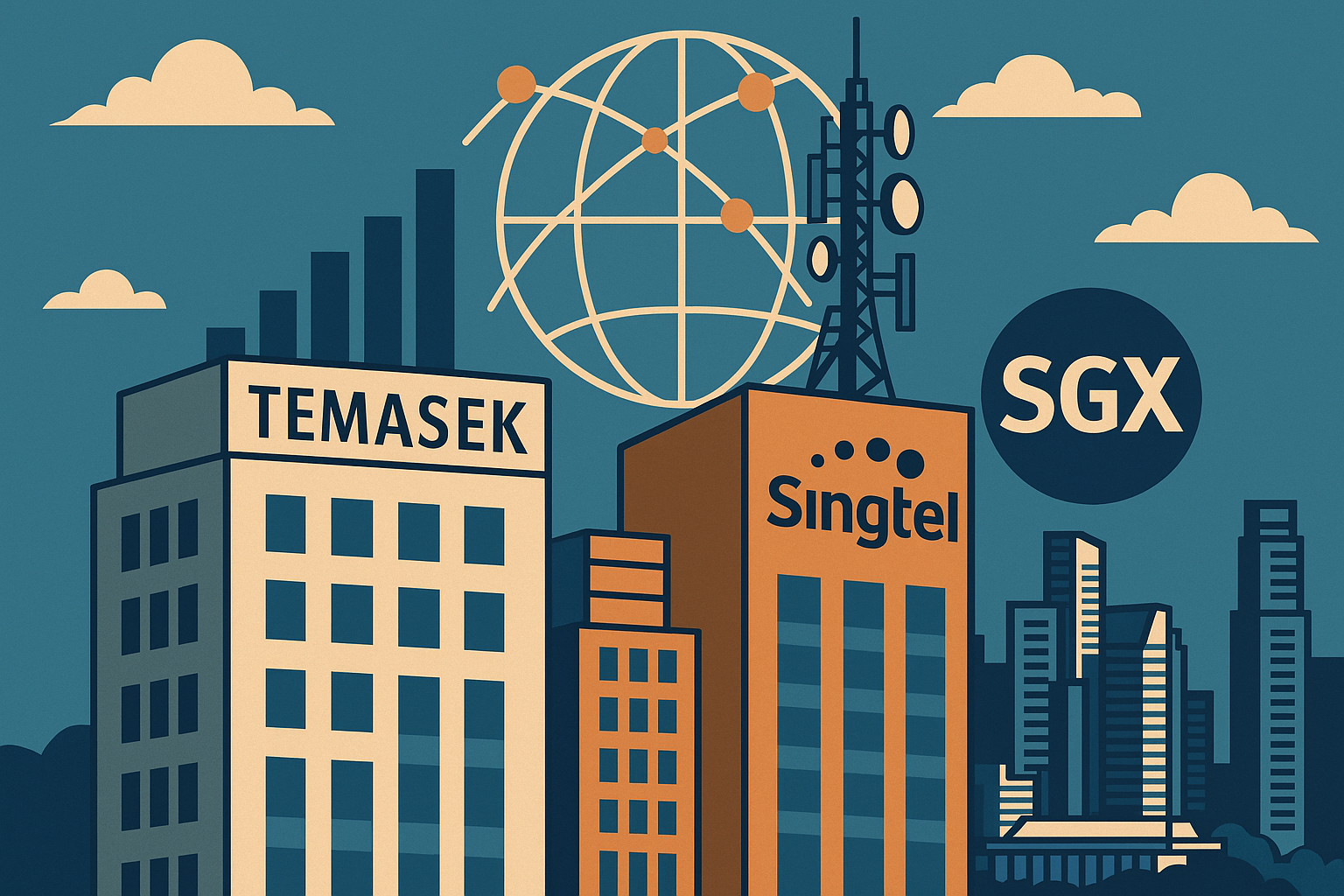
Temasek and Singtel are often mentioned together when discussing Singapore’s capital markets, yet they occupy very different places in the financial ecosystem. Temasek is a state-owned investment company, effectively a sovereign wealth fund, while Singtel is a publicly listed telecommunications giant on the Singapore Exchange (SGX). Together, they illustrate how Singapore balances state-led capital allocation with market-based discipline.
Temasek was established in 1974 to hold and manage the Singapore government’s commercial assets on a fully commercial basis. Over the decades, it has evolved from a domestic holding company into a globally diversified investor with exposure to financial services, telecommunications, consumer, transportation, technology, and life sciences. Although it is wholly owned by the Ministry of Finance, Temasek publishes annual reviews, audited financials, and portfolio breakdowns, and emphasizes a “generating sustainable long-term returns” mandate rather than short-term fiscal support.
One of the key features of Temasek’s role in the market is its dual identity. It is not listed on SGX, so retail investors cannot buy Temasek shares directly. However, Temasek is a major shareholder in many of Singapore’s blue-chip companies, including Singtel, DBS Group, CapitaLand-related entities, and major industrials. These holdings make Temasek an indirect but powerful presence in the Straits Times Index (STI). Its active portfolio rebalancing, disposals, and new investments send strong signals about Singapore’s sectoral priorities.
Singtel, by contrast, is a classic listed corporation with a broad shareholder base and daily trading on the SGX. Traditionally known as Singapore’s dominant telecom operator, Singtel has transformed into a regional communications and digital services group. It owns stakes in mobile operators across Asia and Australia, including Optus in Australia and associates in India, Indonesia, and Thailand. This gives Singtel earnings streams not only from the relatively small domestic market, but from large, fast-growing emerging economies.
From an investor’s point of view, Singtel is both a defensive and cyclical play. Its core connectivity businesses—mobile, fixed-line, and broadband—provide recurring revenue and cash flow, which historically supported consistent dividend payments. At the same time, Singtel faces structural challenges: intense price competition, the capital-intensive roll-out of 5G networks, and changing consumer behavior as voice and SMS are replaced by data-driven apps. Its response has included cost optimization, network modernization, and a push into enterprise ICT, cloud, cybersecurity, and digital infrastructure such as data centers.
Temasek’s long-standing stake in Singtel influences how the market perceives the telco. Temasek’s presence is often interpreted as a vote of confidence in Singtel’s strategic direction and financial resilience. At the governance level, this major shareholder relationship can encourage higher standards of risk management, capital allocation, and board oversight. At the same time, Singtel must still meet the expectations of institutional and retail investors, who focus on profitability, dividend stability, and growth potential across its regional associates.
In the broader context of Singapore’s stock market, Temasek and Singtel together shape sectoral weightings, index performance, and investor sentiment. Temasek steers capital into and out of sectors over long cycles, contributing to the evolution of “Singapore Inc.” Singtel provides a liquid, high-profile way for investors to gain exposure to regional telecom and digital infrastructure from a Singapore listing. Understanding both entities—their mandates, strategies, and interdependence—is essential for anyone trying to grasp how the Singapore market functions and why it looks the way it does.