The Rise of the World’s Tallest Indoor Vertical Farm
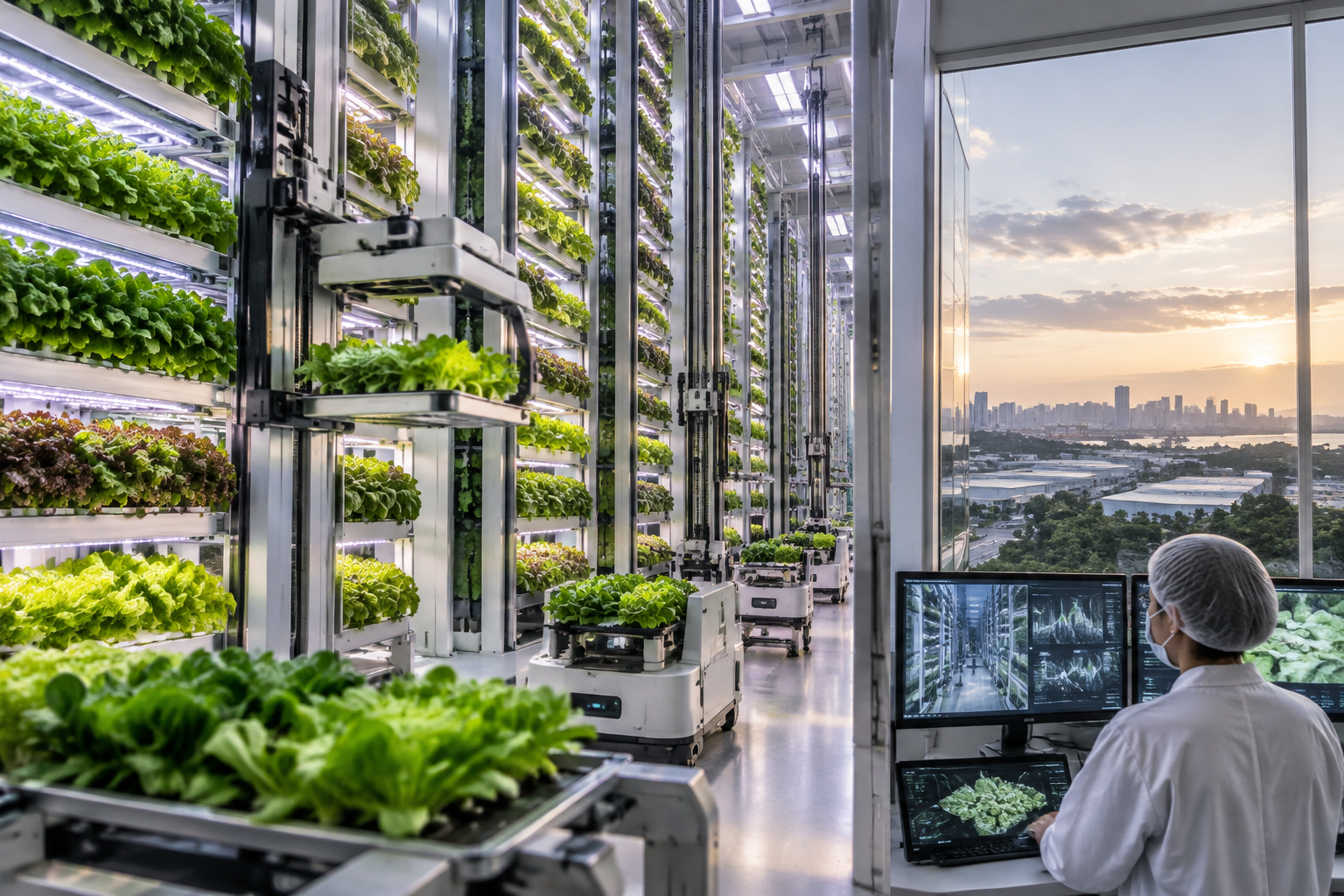
Singapore’s audacious ambition to fortify its food supply has reached a new zenith with the launch of Greenphyto, the world’s tallest indoor vertical farm. Standing over 23 meters high and occupying a five-storey, SGD80 million facility in Jurong West, this fully automated, AI-powered farm represents a significant leap in the nation’s “30 by 30” vision, which aims to produce 30% of its nutritional needs locally by 2030 .
The facility, which officially opened in January 2026, can produce up to 2,000 tonnes of leafy greens annually at full capacity, a volume equivalent to that of dozens of hectares of traditional vegetable fields . Its output includes a variety of produce such as kailan, lettuce, Japanese chye sim, baby spinach, and arugula, now available at major supermarkets under the Hydrogreens brand .
AI and Robotics at the Core of Operations
What sets Greenphyto apart is its reliance on deep technology to achieve efficiency. The farm holds 69 patents and has managed to cut energy use by approximately 30% through customized LED lighting systems tailored to each crop’s specific growth stage . The operation is largely unmanned, with five growing chambers housing hydroponic towers that are monitored by automated, crane-like systems. These robotic systems move seedling trays and adjust nutrients based on AI-driven analysis, while software tracks crop health and predicts yields, alerting staff to potential issues such as leaf discolouration .
Overcoming Economic and Operational Hurdles
Despite the technological triumph, the vertical farming sector in Singapore faces significant economic challenges. A key issue is the “50-cent price gap”—local greens often cost more than double the price of imports from China or Malaysia due to high electricity, labor, and land costs . Greenphyto’s founder, Susan Chong, acknowledges these hurdles, noting that her approach involves learning from past failures in the sector to ensure the produce is both high-quality and cost-efficient .
To mitigate waste and financial risk, the company operates on a make-to-order basis, growing vegetables only after securing orders from retailers . Senior Minister of State for Sustainability and the Environment, Zaqy Mohamad, emphasized that while the farm’s automation and energy efficiency are commendable, maintaining competitive pricing will be crucial for long-term viability .
A Model for Future Urban Agriculture
Singapore’s vertical farming initiatives, exemplified by Greenphyto, are more than just technological showcases. They represent a strategic shift towards a more resilient food ecosystem. By integrating advanced automation, AI, and sustainable practices, these projects are laying the groundwork for a future where urban centers can produce a significant portion of their own food, reducing reliance on volatile global supply chains. As the sector matures, the lessons learned from balancing innovation with economic realities will be invaluable for other cities facing similar land and resource constraints.