
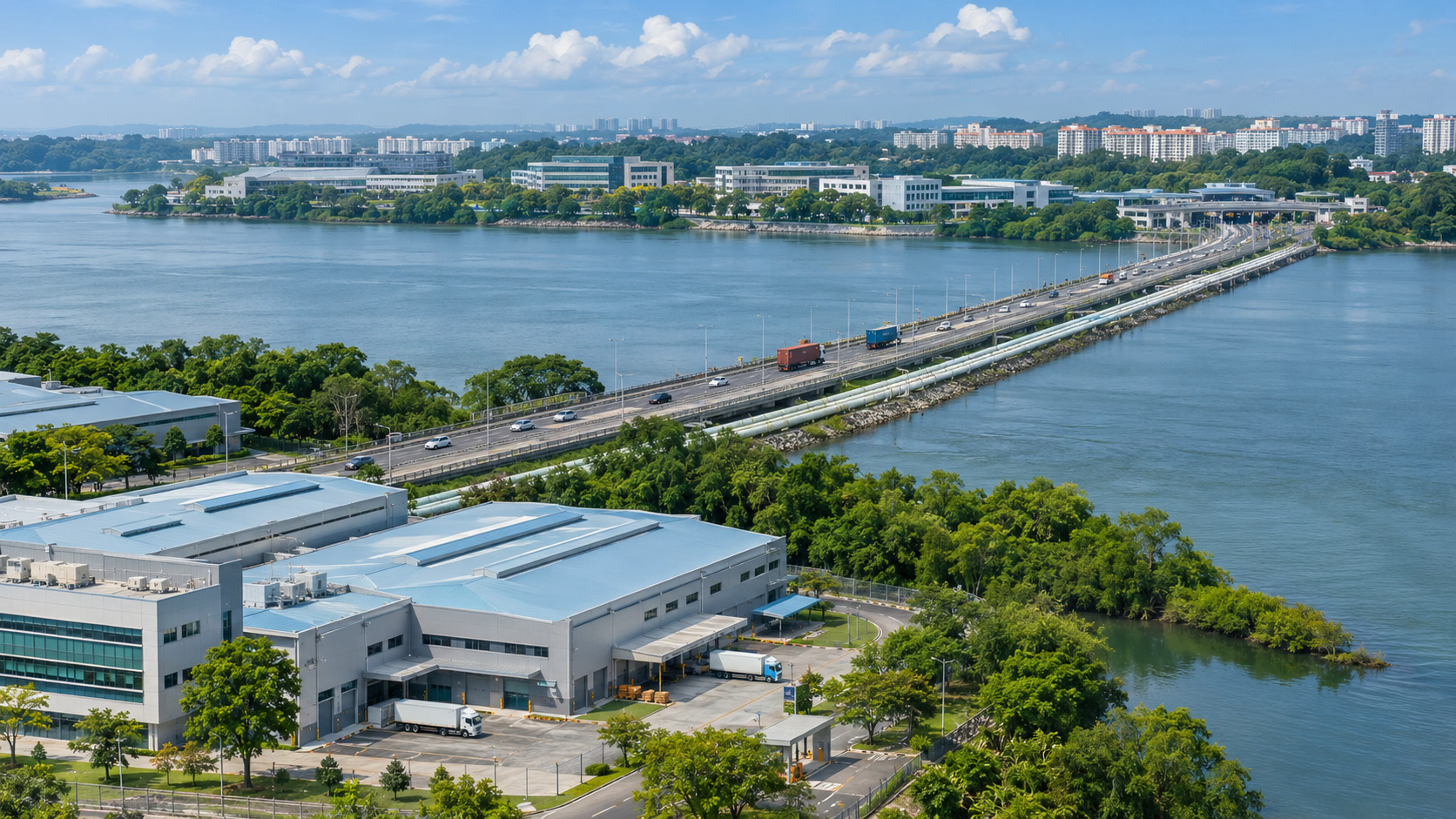
Why Global Manufacturers Are Splitting Operations Between Singapore and Johor
The classic model of ASEAN expansion — lease a regional office in Singapore, then figure out the rest — is giving way to a more operationally integrated approach. Under the SG+ Twinning Model, promoted by the Singapore Economic Development Board (EDB), global companies anchor high-value functions such as headquarters, R&D, supply chain control, and advanced manufacturing in Singapore, while placing complementary production and volume-driven operations in nearby Johor, Malaysia, or the Batam-Bintan-Karimun clusters in Indonesia.
This is not merely a cost-arbitrage story. It is a risk-management architecture. By keeping intellectual property, product charters, and commercial decision-making in Singapore’s trusted legal and financial environment, manufacturers retain control over quality and compliance while tapping lower-cost land and labour across the causeway. The Johor-Singapore Special Economic Zone formalizes this logic, with both governments working to reduce friction in cross-border flows of goods and people.
SPC Group’s Integrated Bet on Singapore and Johor
The most concrete validation of the twinning model comes from South Korea’s SPC Group. The food company established its regional headquarters and R&D centre in Singapore in 2023, then launched a RM 143 million halal manufacturing facility in Johor in February 2025. The Johor plant produces 11 tonnes of dough daily for Southeast Asian and Middle Eastern markets, with finished goods trucked to Singapore weekly. The arrangement allows SPC to keep innovation and management functions in Singapore while scaling production in a cost-competitive location — a template now being studied by other mid-sized manufacturers in food, consumer goods, and specialty chemicals.
What the Data Says About ASEAN’s Investment Pull
The twinning model is unfolding against a backdrop of resilient FDI into Southeast Asia. According to the ASEAN Investment Report 2025, the region attracted US$226 billion in FDI in 2024, accounting for 15 per cent of global inflows and marking an 8 per cent year-on-year rise. Greenfield investment in digital-related sectors more than doubled to US$16 billion, while manufacturing FDI rose 147 per cent, particularly in automotive, electronics, and semiconductors. Singapore functions as the command centre for much of this capital — not because factories are disappearing from the region, but because the region’s production footprint is becoming more distributed.
The Operational Playbook for Global Teams
For companies managing ASEAN expansion from a single hub, the SG+ model demands a different operating rhythm. Supply chain managers in Singapore oversee inventory flows across multiple production nodes. Compliance teams in Singapore manage rules-of-origin documentation for goods that cross borders before final assembly. R&D teams in Singapore design products for regional preferences while Johor or Batam plants handle batch production. This is launchpad 2.0: not a single address for regional business, but a control tower for a deliberately fragmented — and therefore more resilient — operating model.
A practical guide to structuring this model, published by EDB in September 2026, outlines how companies can use Singapore as the anchor while distributing execution across the region.