
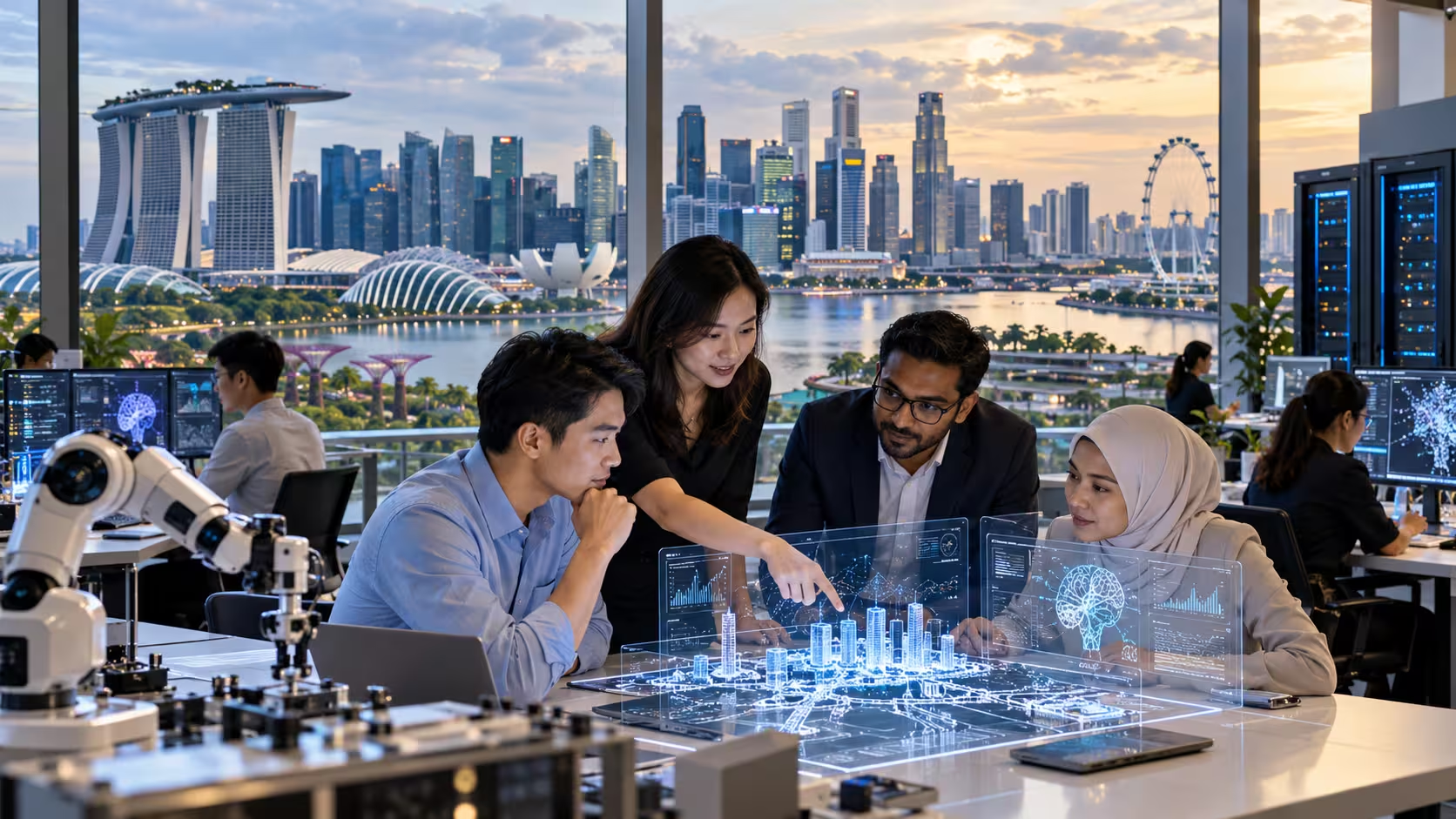
The Scale of Singapore’s AI Transformation
Singapore has quietly become one of the world’s most concentrated nodes of artificial intelligence activity. As of September 2026, the city-state hosts nearly 100 dedicated in-house AI teams—known as AI Centres of Excellence—established by companies across diverse sectors. These centres are not merely satellite offices; they are fully operational R&D and deployment units that develop customised AI solutions, create high-value jobs, and deepen local AI expertise. The Economic Development Board (EDB) of Singapore has been the central architect of this transformation, supporting companies in setting up these centres through a combination of incentives, partnerships, and ecosystem facilitation.
Why Global Companies Are Choosing Singapore
The concentration of AI Centres of Excellence in Singapore is no accident. Global firms such as OpenAI, NVIDIA, KPMG, Mastercard, Sea Group, and Singtel have all established or expanded AI facilities in the city-state over the past two years. Several factors converge to make Singapore uniquely attractive. First, its regulatory environment is both business-friendly and increasingly sophisticated in AI governance—a balance that multinational corporations find difficult to replicate elsewhere. Second, Singapore’s talent pipeline, anchored by world-class universities like NUS, NTU, and SMU, provides a steady stream of AI-capable graduates. Third, the government’s commitment is substantial: a S$1 billion five-year national plan to boost AI research in public institutions complements the private-sector centres of excellence, creating a dense innovation network that benefits both enterprises and researchers.
The Economic Ripple Effects
The impact of these centres extends far beyond their own operations. Each AI Centre of Excellence typically creates dozens to hundreds of high-value roles—AI engineers, research scientists, product managers, and forward-deployed engineers who work directly with client organisations to solve real-world problems. Sea Limited’s AI Centre of Excellence, for example, is expected to generate demand for at least 100 R&D and innovation-centric roles in Singapore over three years, spanning AI research, engineering, and product development. These positions command competitive salaries and contribute to Singapore’s broader ambition of becoming a knowledge-driven economy. Beyond direct employment, the centres stimulate demand for supporting services—cloud infrastructure, data engineering, legal and compliance expertise, and specialised AI consulting—creating a multiplier effect across the local tech ecosystem.
A Magnet for Both Western and Chinese AI Firms
What distinguishes Singapore from other AI hubs is its ability to attract companies from both sides of the geopolitical divide. U.S. firms like OpenAI, Google DeepMind, and Anthropic have established significant presences, while Chinese AI companies including Manus AI, Tencent, and Alibaba have also chosen Singapore as a critical first step in their global expansion. This neutrality positions Singapore as a rare bridge in an increasingly fragmented global AI landscape. For firms of Chinese origin, Singapore offers access to international markets, robust intellectual property protection, and a familiar business environment. For Western companies, it provides a gateway to Southeast Asia’s fast-growing digital economy and a trusted regulatory sandbox for testing AI applications in sectors such as finance, healthcare, and public services.
The Road Ahead
Singapore’s AI Centre of Excellence ecosystem is still expanding. With the government’s National AI Strategy 2.0 providing strategic direction and EDB actively courting global AI leaders, the pipeline of new centres remains robust. The challenge ahead lies not in attracting more centres, but in ensuring that the ecosystem generates tangible outcomes—commercialised products, improved public services, and a workforce equipped to thrive alongside AI. Singapore’s approach suggests that a small city-state can punch far above its weight in the global AI economy by combining strategic government support with an open, trusted, and talent-rich environment.