
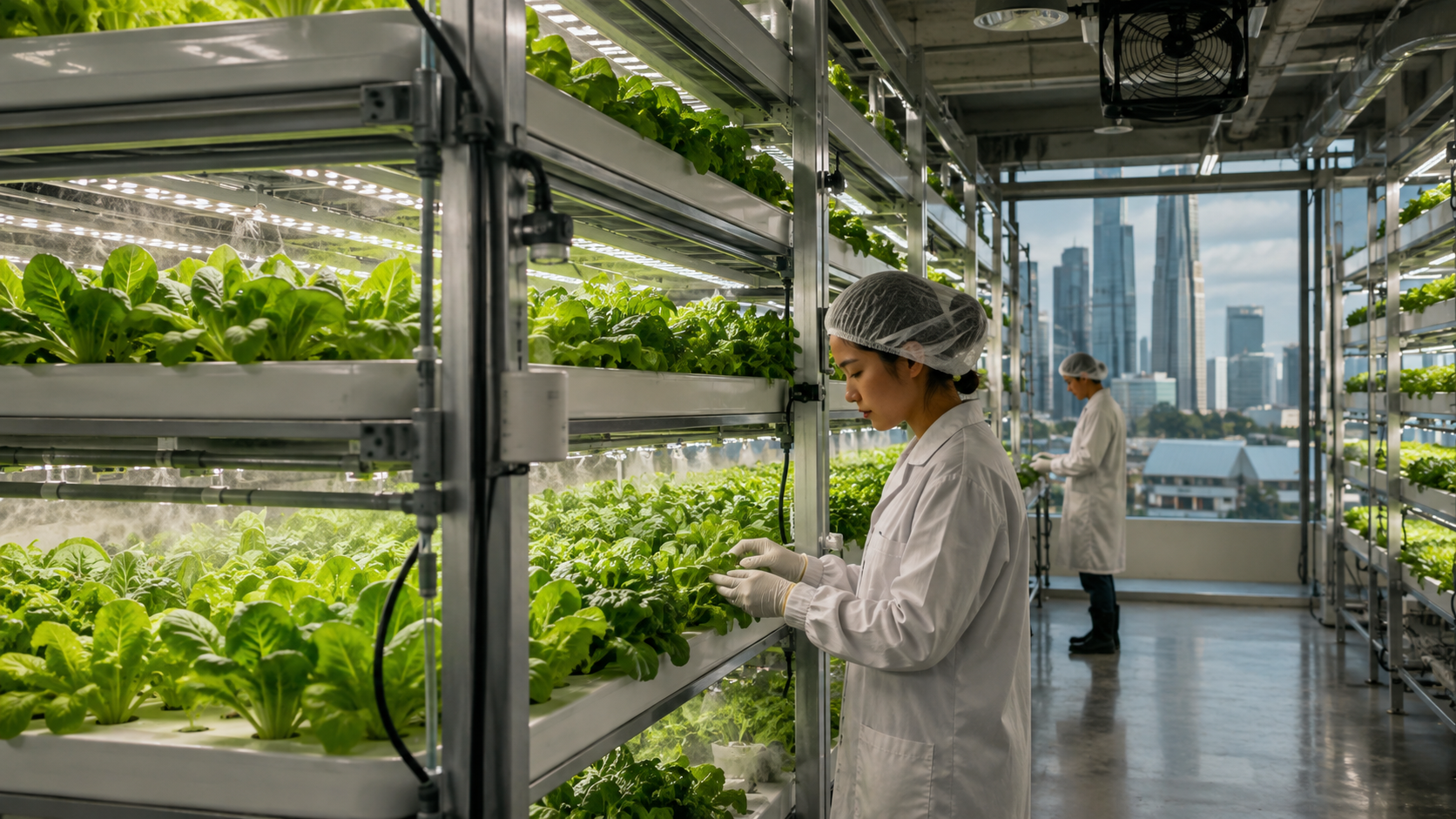
Singapore imports more than 90 percent of its food and dedicates less than 1 percent of its land to agriculture. That imbalance has made food security a national priority, and the government’s “30 by 30” goal—producing 30 percent of nutritional needs locally by 2030—has placed agritech startups at the center of the conversation. According to the Singapore Food Agency’s official 30 by 30 page (https://www.sfa.gov.sg/, accessed 2026), the target is designed to protect the city-state from global supply disruptions and climate-related shocks. Vertical farming has emerged as one of the most visible and viable responses.
Why Vertical Farming Is a National Imperative
The 30 by 30 Challenge in Numbers
Singapore’s scarce arable land forces growers to look upward rather than outward. Indoor vertical farms can produce multiple crop cycles per year in tightly controlled environments. This model reduces dependence on weather, cuts water use by up to 95 percent in hydroponic systems, and shortens supply chains. For a country that relies heavily on imported vegetables, local vertical farms are no longer just pilot projects—they are becoming part of Singapore’s food resilience infrastructure.
Inside the Tech Stack of Singapore’s Vertical Farms
AI, Sensors, and Precision Climate Control
Modern vertical farms in Singapore depend on a dense network of sensors that measure temperature, humidity, carbon dioxide, and nutrient concentration. Machine-learning algorithms adjust LED light spectra, irrigation schedules, and airflow in real time. This precision agriculture approach allows growers to fine-tune crop development, improve yields, and reduce energy waste. Aeroponic systems mist plant roots with nutrients, while hydroponic trays recirculate water continuously. These closed-loop systems fit Singapore’s urban constraints because they can operate inside industrial buildings, repurposed warehouses, and even underground spaces.
Real-World Startups Turning Headlines into Harvests
Several companies illustrate the sector’s momentum. Sustenir Agriculture grows non-native crops such as kale, strawberries, and arugula in climate-controlled indoor farms, selling directly to supermarkets and restaurants. Archisen combines IoT sensors with automated farming software to operate compact urban farms that monitor plant health remotely. Sky Greens, one of the earlier players, uses a low-carbon hydraulic vertical system to grow leafy vegetables in tall greenhouses. These startups show that vertical farming in Singapore has moved beyond leafy greens into higher-value produce, although leafy vegetables remain the most commercially viable category due to fast growth cycles and consistent demand.
From Niche Innovation to Scalable Food Security
The biggest hurdle remains energy cost. Climate control and LED lighting are electricity-intensive, which can make vertically farmed produce more expensive than imported alternatives. To address this, startups are experimenting with solar integration, more efficient LEDs, and heat recovery systems. Government grants and test-bedding sites help reduce capital expenditure. As the 30 by 30 deadline approaches, vertical farming is expected to contribute a larger share of local vegetable production, especially for high-turnover crops that can justify the economics. The next phase will likely involve consolidation, automation, and partnerships with real estate developers to embed farms directly into urban infrastructure.